


When our team first began experimenting with AI Overviews and conversational tools like ChatGPT, one pattern became clear fast: visibility no longer depends solely on ranking first. It depends on being chosen when summarizing answers for your audience. Tools like Google’s AI Overviews, ChatGPT, Perplexity, and Gemini pull from sources they trust, understand, and can easily interpret.
A quick way to test your own brand visibility is by asking ChatGPT: “What do you know about [my brand]?” What comes back? Is it accurate? Outdated? Vague? Or does it know nothing at all? If your content isn’t being surfaced or is being surfaced incorrectly, the issue won’t be solved by aiming for a #1 keyword ranking. It’s solved by strengthening your structure, trust signals, and both human- machine-readability.
Note: We do NOT recommend doing this for checking your visibility on Google. Learn why.
Below are the most common mistakes keeping great websites invisible in the age of AI search, and how to fix them.
5 Mistakes Hurting Your AI Visibility
1. Your Content Isn’t Structured For Machine Understanding
AI can’t surface your content if it isn’t structured in a way machines understand. Clear formatting and schema markup give AI the signals it needs to identify, interpret, and cite your pages.
AI systems don’t “read” on-page content the way humans do. They rely on patterns, hierarchy, and structured signals to determine what a page is about and whether it’s relevant to a query. When content is buried in long paragraphs, missing schema markup, or disconnected from related entities, AI has a much harder time extracting context. This is why formatting, headings, and structured data play such a major role in modern discoverability.
Common signals your structure is holding you back:
Missing schema markup (Organization, Article, FAQ, How-To, Author)
Walls of text with no headings, bullets, or visual structure
No “answer-first” intro that offers a concise summary
Headings that don’t match how users actually ask questions
Content that is helpful, but not machine-readable
AI needs clear signals like:
What is this page about?
Who wrote it?
What role does content play?
How is this entity connected to others on the site?
How to fix it:
Lead with clear, factual answers in the first 100-150 words
Use question-based H2/H3s
Add structured data (FAQ, Article, Organization, and Person schema)
Break content into scannable, extractable sections
When your pages are structured clearly, AI can finally understand what your content means and when to surface it.
2. You’re Not Establishing Enough Trust Signals (E-E-A-T)
AI tools surface content they trust, not just content that exists. If your pages lack proof of expertise, freshness, or credibility, they’re unlikely to be chosen for summaries.
Generative engines prioritize information that feels reliable—content with clear authorship, up-to-date sources, and signals of real expertise. This is where E-E-A-T (Experience, Expertise, Authoritativeness, Trustworthiness) plays a major role. When posts are outdated, lack citations, or present generic insights, AI treats them as having lower value, even if the writing is strong. Reinforcing trust through bios, data, firsthand experience, and regular updates helps AI distinguish authoritative content from the rest of the web.
Common trust gaps:
No author bios or missing credentials
Outdated posts with old data or broken links
Thin “surface-level” content
No external citations or references
No proof of first-hand experience or expertise
AI models are trained to avoid hallucinations (even if they still occur). They rely heavily on content that is verifiable and authoritative.
How to fix it:
Add transparent author bios with credentials
Include citations from reputable, primary sources
Update posts regularly
Incorporate examples, data, and first-hand insights
Ensure your brand identity is consistent across the web
Strengthening E-E-A-T gives AI the confidence it needs to trust your content and choose it over less credible alternatives.
3. Your Entity Footprint is Inconsistent or Unclear
If AI can’t recognize your brand as a defined, consistent entity, it won’t reference you. Clear and aligned brand signals help generative tools understand who you are and how your content fits together.
AI models build knowledge by mapping connections between your brand, authors, services, and content. When those signals differ across your website, your social profiles, and schema markup, the model struggles to establish a confident understanding of your identity. This makes your content harder to associate with relevant topics. Consistent descriptions, linked authorship, and strong internal connections make your brand more “legible” to AI, increasing your chances of being cited. Strong entity clarity is one of the most effective strategies for enhancing AI visibility, especially as AI platforms become primary discovery channels.
Signs your entities are unclear:
Your brand description varies between your site, LinkedIn, social channels, and Google Business Profile
Your authors aren’t consistently referenced or connected
AI tools produce vague or incorrect descriptions when asked about your company
No internal linking between related pages or authors
How to fix it:
Use consistent brand descriptions everywhere
Add Person schema to author pages and Organization schema sitewide
Link authors to topics and services they specialize in
Strengthen internal links between related concepts
When AI “understands” your brand as an entity, your visibility increases everywhere, especially in summaries.
4. You’re Still Writing for Keywords, Not Conversations
Generative engines prioritize content that answers questions naturally, not content overloaded with keywords. AI favors clear, conversational explanations that mirror how real people ask things.
AI search focuses on user intent, the actual questions behind the words. Keyword-heavy copy often feels rigid and artificial, making it harder for AI to determine whether it’s genuinely helpful. When content is written in the same language people use when talking or searching, models can match more easily to conversational queries. Direct answers, long-tail phrasing, and human-centered structure make your content more compatible with AI summaries.
Patterns AI does NOT prefer:
Keyword-stuffed paragraphs
Robotic, formulaic copy
Over-optimized H2s
Content that never directly answers a question
Patterns AI loves:
Conversational phrasing
Long-tail, natural language
Short, direct answers followed by depth
FAQs and sections answering specific user questions
How to fix it:
Rewrite copy to be conversational
Add FAQ targeting natural-language questions
Use “people also ask” phrasing in headers
Include examples, comparisons, and plain-English explanations
When your content sounds like your users, AI can match it more easily to real questions, making your pages far more visible.
5. Weak UX Signals Are Telling AI Your Content Isn’t Helpful
Poor user experience sends AI the message that your content isn’t valuable. Slow speeds, accessibility issues, and confusing layouts reduce engagement and visibility.
AI systems increasingly learn from how people interact with your site. If visitors bounce quickly, struggle to read your pages, or encounter technical friction, those signals suggest that the content may not be fulfilling their needs. Clean navigation, readable formatting, fast load times, and accessible design all help keep users engaged. Higher engagement reinforces to AI that your content delivers value, making it more likely to be included in generated responses.
UX issues that harm AI visibility:
Slow site speed
Poor mobile experience
Low-contrast text
Long paragraphs with no whitespace
Confusing navigation
Missing alt text
How to fix it:
Improve Core Web Vitals
Make your layout scannable and easy to digest
Add alt text and captions
Simplify navigation and user flows
Good UX strengthens both human engagement and machine trust.
A Deeper Look At How to Improve Your AI Visibility
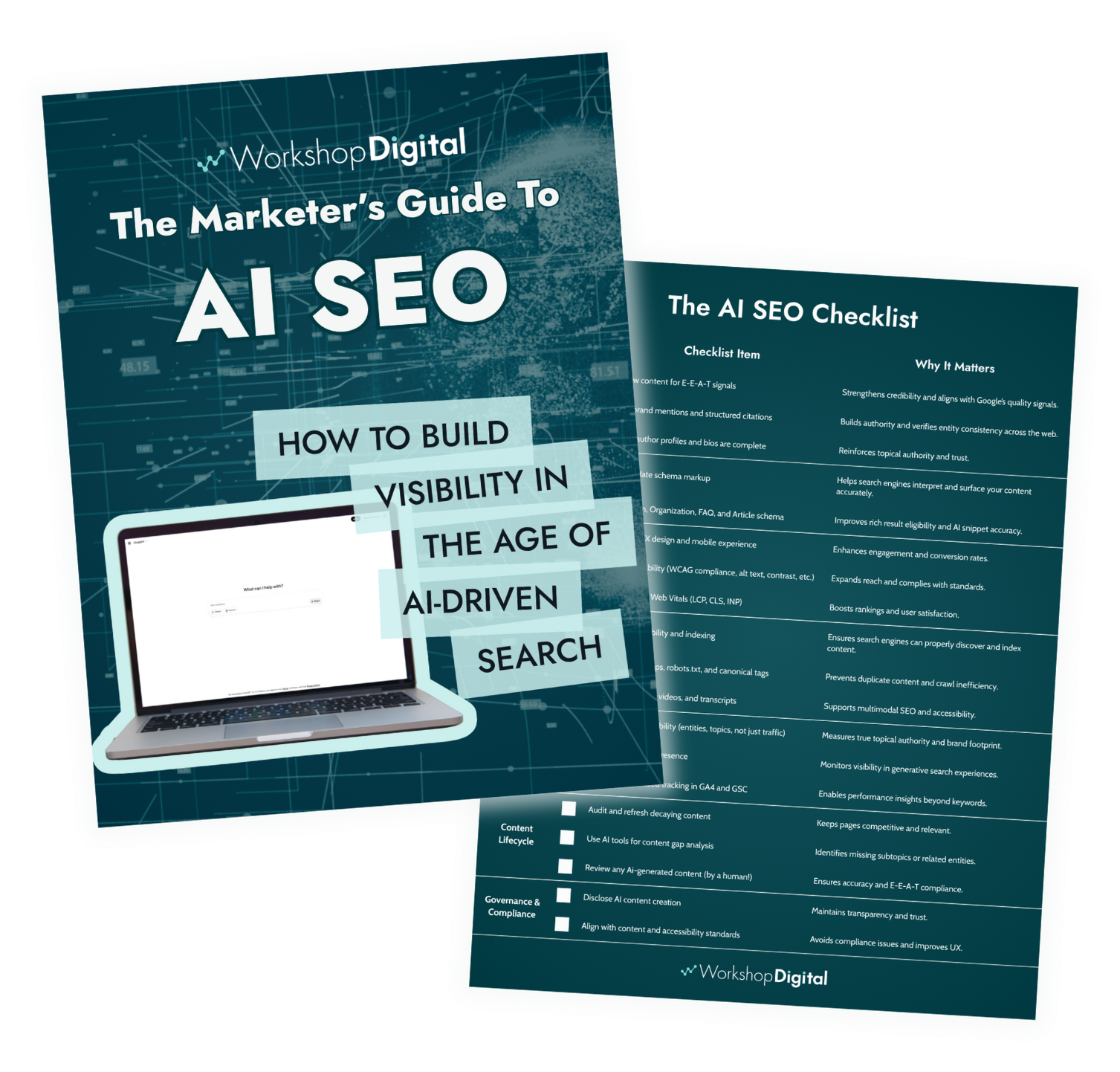
Our Marketer's Guide to AI SEO breaks down the exact steps to strengthen your structure, clarify your content, and increase your chances of being selected by AI systems.
It also includes a visibility checklist you can use to audit your pages in minutes. Perfect for spotting issues, prioritizing fixes, and leveling up your AI presence.
Visibility Isn’t Accidental; It’s Engineered
As AI-driven search reshapes how people find answers, your visibility depends on how well your content can be found, understood, and trusted by both humans and machines. The brands winning AI-driven search are focusing on producing clearer signals. Signals that tell AI who they are, what they know, why they’re credible, and how their content fits together.
If your website isn’t surfacing in AI summaries, it’s not because your content isn’t good; it’s because the signals supporting it aren’t strong enough yet. The sooner you strengthen your signals, the sooner AI-driven platforms will start choosing your content.
Want a deeper roadmap? Download The Marketer’s Guide to AI SEO to learn how to improve structured data, strengthen trust, build entity authority, and measure visibility across AI-driven search experiences. It explains how AI systems interpret your pages and what small, intentional updates can make the biggest difference. Strengthening your AI visibility starts here.
AI will choose someone’s content. Make sure it’s yours.

