

Google is sending less traffic to websites than ever before.
According to SparkToro's 2026 research, 68% of Google searches now end without a click. At first glance, that sounds like bad news for marketers and SEOs. Dig a little deeper, though, and the data tells a more interesting story. Nearly 30% of those zero-click searches lead to another search, which suggests many users aren't finding what they need immediately. They're refining queries, comparing options, and continuing their research.
That's exactly the behavior Google AI Mode is built for.
Unlike AI Overviews, which generate a summary above traditional search results, AI Mode is designed to support the entire search journey. Users can ask complex questions, follow up with additional context, compare products or services, and explore a topic without starting a new search from scratch.
For users, that creates a more conversational search experience. For marketers and SEOs, it changes how visibility is earned.
Ranking well still matters, but showing up in AI-generated responses matters too. As more users interact with AI Mode, brands need to think beyond traditional rankings and consider how their content, expertise, and brand signals influence the answers Google generates.
In this post, I'll cover how Google AI Mode works, how it differs from AI Overviews, what's changed since launch, and what brands can do to improve visibility across both traditional search results and AI-powered search experiences.
What is Google AI Mode?
Google AI Mode is Google's conversational search experience powered by Gemini.
Instead of returning a list of links and expecting users to piece together the answer themselves, AI Mode generates a response based on information it finds across the web and allows users to continue the conversation with follow-up questions.
Think of it as the difference between searching and researching.
A traditional Google search might require several queries, multiple browser tabs, and a fair amount of back-and-forth before you find the information you're looking for. AI Mode is designed to keep that entire process within a single experience.
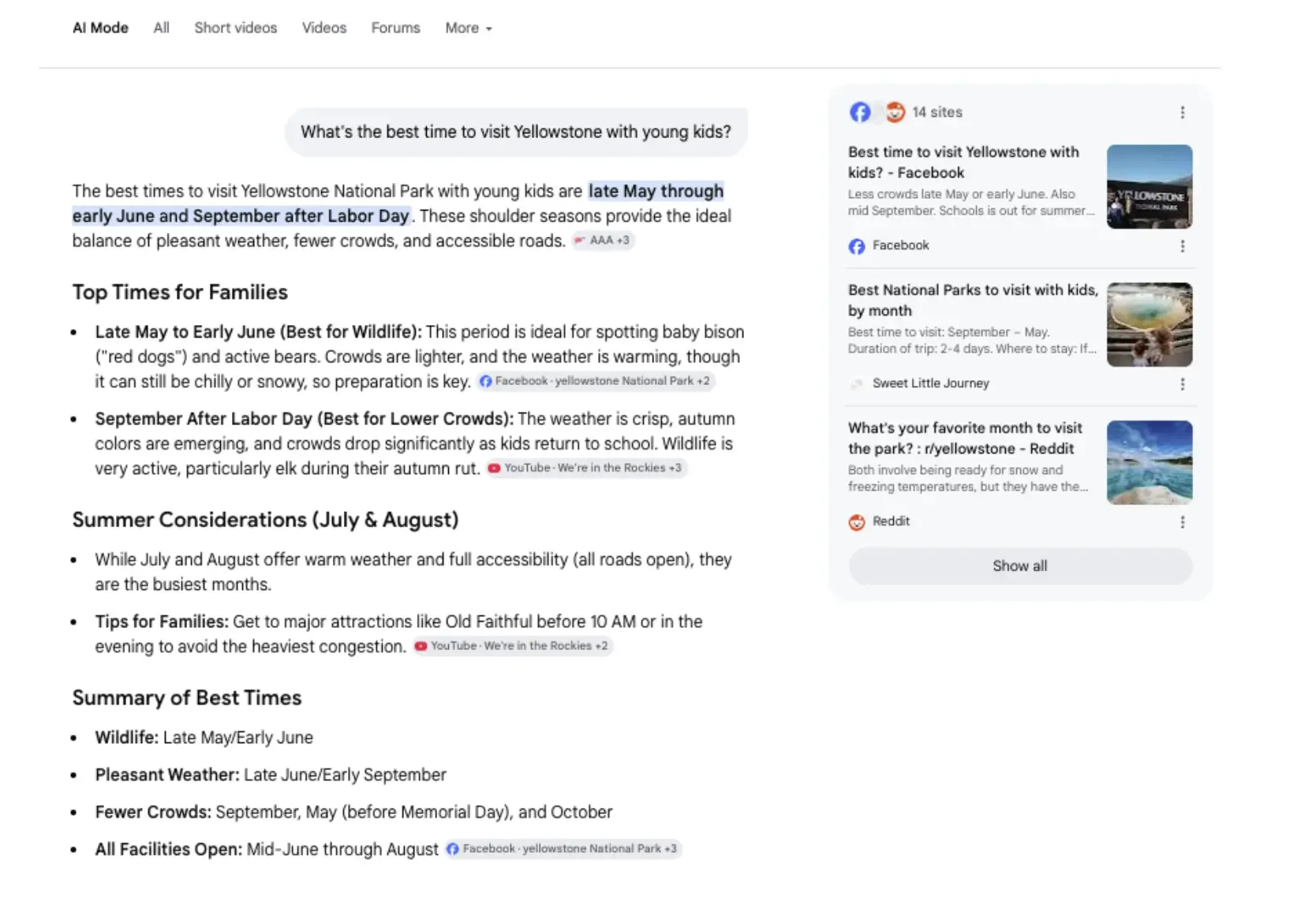
For example, someone planning a family vacation could ask:
"What's the best time to visit Yellowstone with young kids?"
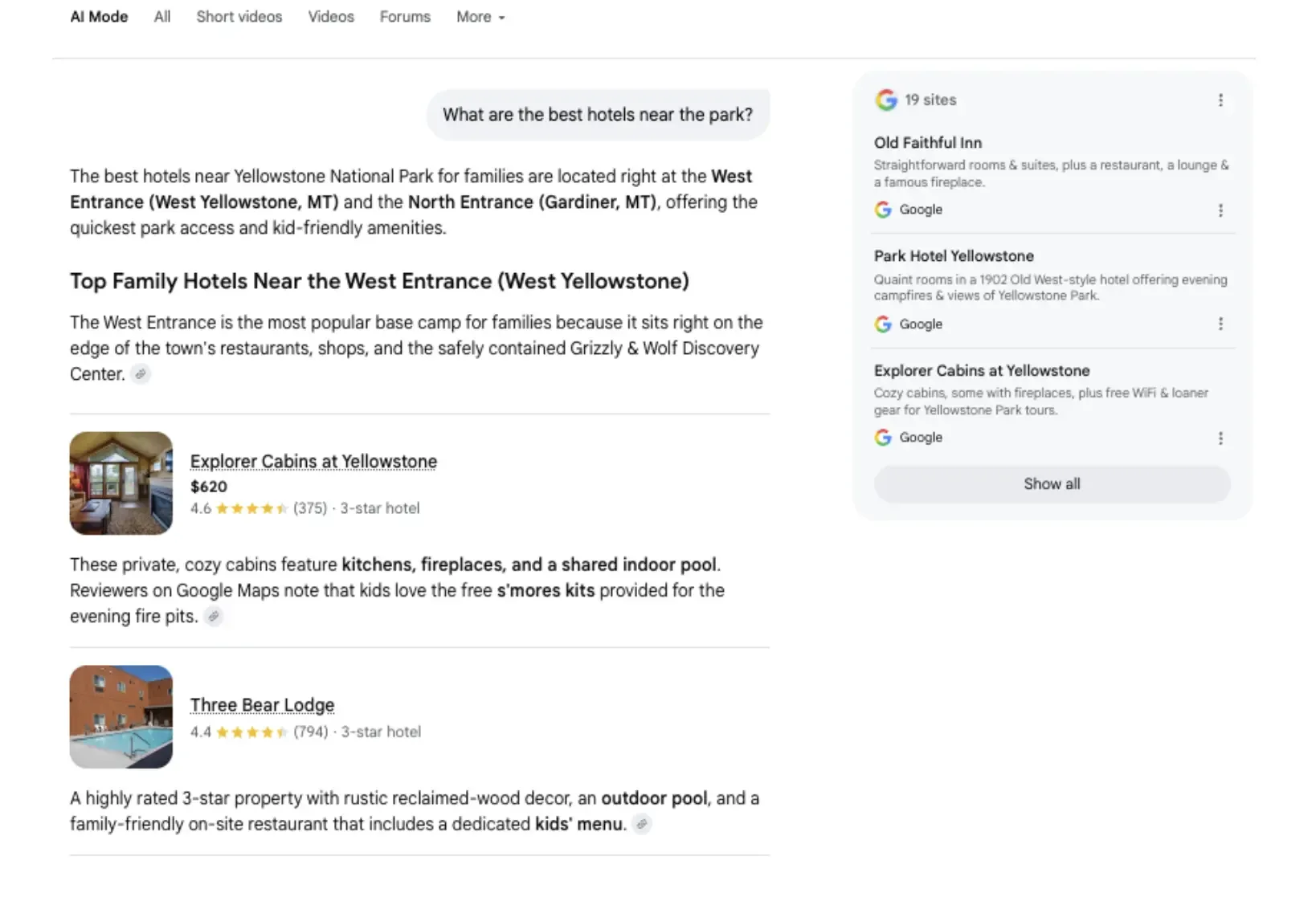
They could then follow up with: "What are the best hotels near the park?"
And then: "Which of those hotels have pools and family suites?"
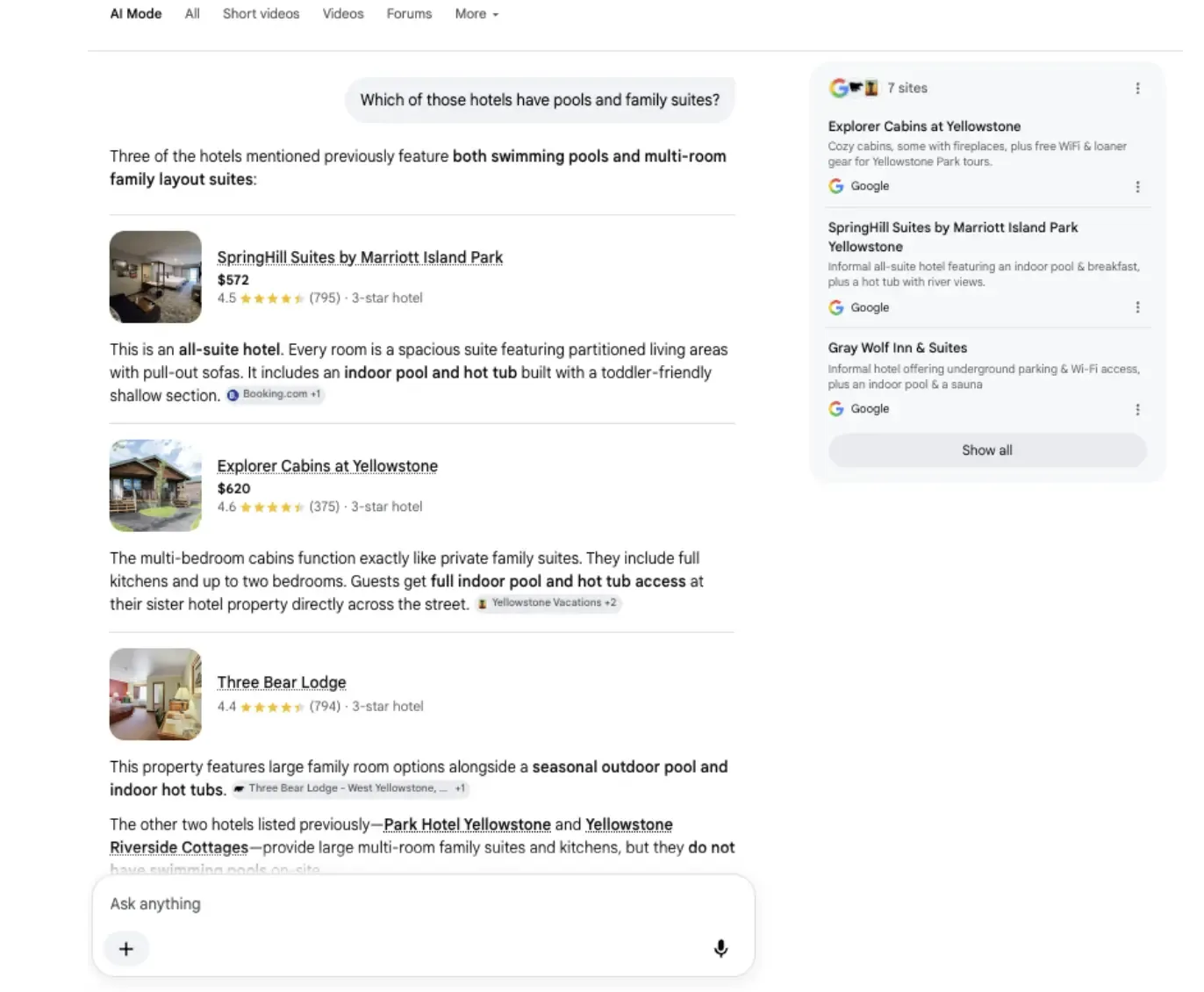
Instead of starting over with a new search each time, AI Mode remembers the context and builds on previous questions.
Google accomplishes this using a technique called query fan-out, where the system breaks a question into multiple related searches, gathers information from different sources, and combines those findings into a single response.
The result is a search experience that feels less like browsing a directory of websites and more like having a conversation with a research assistant.
Google AI Mode vs. AI Overviews
Google AI Mode and AI Overviews are both powered by Gemini, but they serve different purposes.
AI Overviews are designed to answer a question directly within the search results page. They generate a summary above traditional organic listings, helping users get a quick answer without clicking through multiple websites.
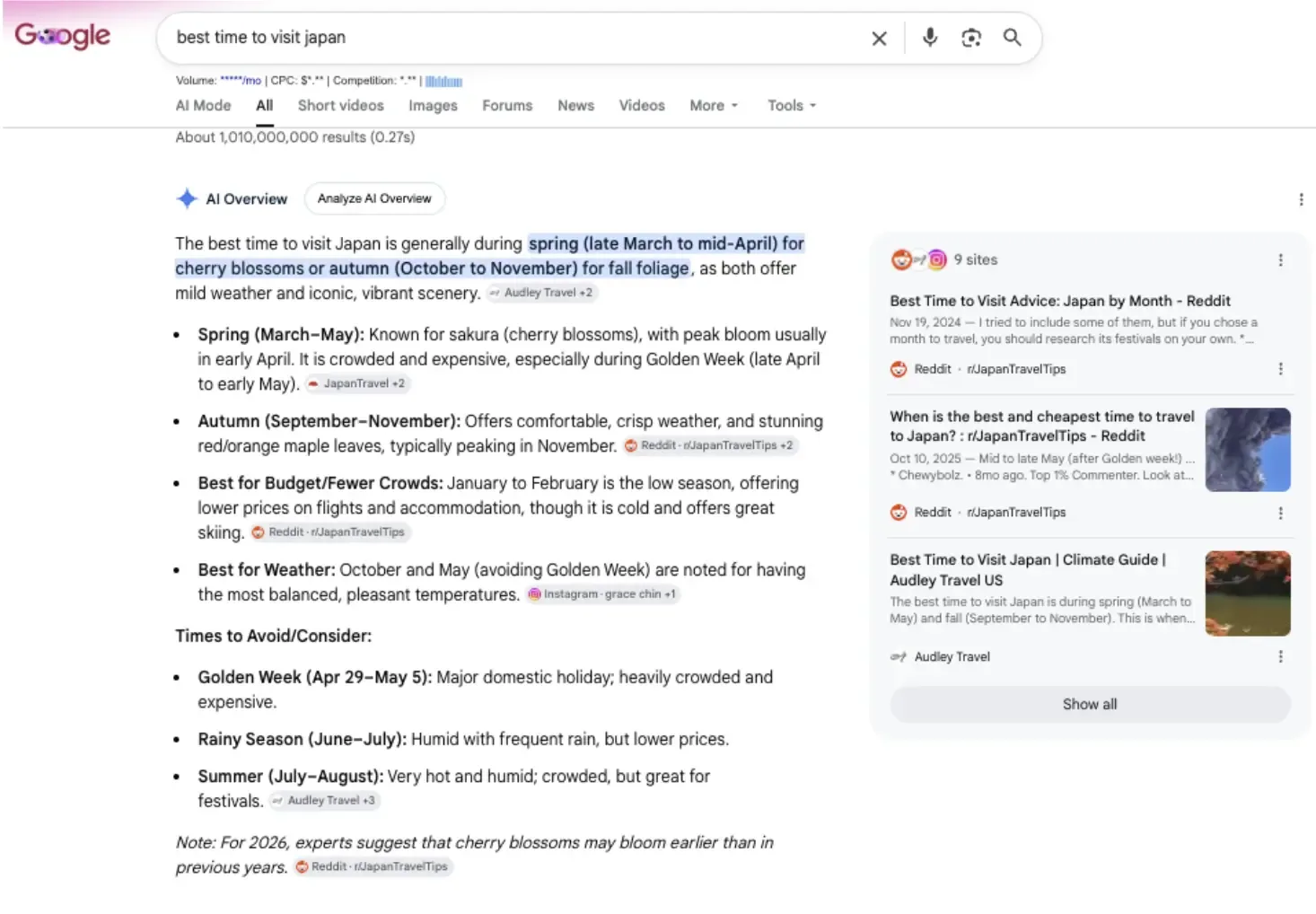
AI Mode takes that concept much further.
Instead of generating a single response, AI Mode creates an interactive search experience where users can ask follow-up questions, refine their searches, compare options, and explore a topic in greater depth. It remembers the context of previous questions, allowing users to continue the conversation without starting a new search each time.
The easiest way to think about it is this: AI Overviews help users answer a question; AI Mode helps users work through an entire topic.
| AI Overviews | AI Mode |
| Generates a summary within search results | Creates a conversational search experience |
| Best for quick answers | Best for complex questions and research |
| Traditional search results remain visible | Focus shifts to the AI-generated response |
| Limited interaction | Supports follow-up questions and context |
| Designed to answer a query | Designed to support a search journey |
This distinction matters for marketers because the visibility opportunities are different. In AI Overviews, users can still browse traditional search results alongside the generated summary. In AI Mode, users are more likely to stay within the conversation, making citations, brand mentions, and trusted sources increasingly important.
From Search Experiment to Mainstream Search Experience
When Google introduced AI Mode in early 2025, access was limited to users in Search Labs. It was positioned as an experimental way to search, giving users the ability to ask more complex questions and continue the conversation through follow-up prompts. Today, AI Mode is no longer an experiment.
Google has expanded AI Mode globally, integrated it more deeply into Search, and introduced new capabilities that extend far beyond answering questions. At Google I/O 2026, the company announced that AI Mode had surpassed one billion monthly users, making it one of the fastest-growing products in Google's history.
That growth reflects a broader shift in how people search.
Traditional search works well when users know exactly what they're looking for. But many searches aren't that straightforward. Planning a trip, comparing software platforms, researching a medical condition, or evaluating service providers often requires multiple searches, dozens of webpages, and a lot of back-and-forth.
AI Mode is designed to reduce that friction by helping users explore a topic within a single search experience.
The result is a version of Search that looks less like a directory of websites and more like a research assistant that can gather information, answer follow-up questions, and help users make decisions.
And Google isn't slowing down. Since launch, the company has introduced new capabilities that make AI Mode more personalized, more capable, and more useful for complex tasks.
What’s New in Google AI Mode?
When AI Mode launched, its primary differentiator was the ability to answer complex questions and support follow-up conversations. Since then, Google has expanded AI Mode far beyond conversational search.
Today, AI Mode can help users conduct deep research, personalize responses based on information from Google products, and even complete tasks on their behalf. These updates are changing not only how people search, but also how businesses need to think about visibility.
Deep Search
Anyone who has used ChatGPT, Gemini, or Perplexity for research knows the feeling. You ask a question, get an answer, realize you need more context, ask another question, and repeat the process until you've pieced everything together.
Deep Search is basically Google's way of saying, "We'll go down the rabbit hole for you."
Instead of running a handful of searches behind the scenes, Deep Search can issue dozens or even hundreds of searches across related topics, synthesize the findings, and generate a fully cited response. The goal is to help users move from question to research report in a matter of minutes.
For marketers, this increases the importance of creating content that is comprehensive, trustworthy, and easy for Google to cite when assembling answers from multiple sources.
Personal Intelligence
Google has also introduced Personal Intelligence, which allows AI Mode to personalize responses using information from a user's connected Google products.
Depending on permissions and settings, AI Mode can pull context from Gmail, Google Photos, and other Google properties to deliver more relevant recommendations and answers.
A user searching for travel recommendations, for example, could receive suggestions informed by previous trips, reservations, or preferences stored within Google's ecosystem.
This level of personalization means two users may receive very different responses to the same query, making visibility less about ranking for a single keyword and more about building a strong brand presence across multiple touchpoints.
AI Agents and Agentic Search
Google is also moving AI Mode beyond answering questions and into helping users complete tasks.
With AI agents, Search can help users compare options, evaluate recommendations, and work through multi-step decisions. Rather than acting solely as an information retrieval system, Search is beginning to function more like an assistant.
This shift is important because users may spend less time clicking between websites and more time relying on Google's recommendations throughout the decision-making process.
Agentic Calling and Booking
One of the most interesting developments for local businesses is Google's rollout of agentic calling and booking capabilities.
In supported categories, AI Mode can contact businesses on behalf of users to gather information, check availability, or help complete reservations and appointments.
For local SEO, this raises the stakes for maintaining accurate business information. Google Business Profiles, service details, operating hours, reviews, and booking integrations all become more important when Google's systems are acting on behalf of potential customers.
The easier it is for Google's AI systems to understand and interact with your business, the more likely you are to remain visible as these experiences become more common.
How Google AI Mode is Changing SEO & GEO
For years, SEO was largely about earning visibility in a list of search results. While rankings are still important, AI Mode introduces a new challenge: earning visibility within the answer itself.
When users interact with AI Mode, they aren't simply scanning a page of links. They're asking questions, refining their searches, comparing options, and relying on Google's responses to guide their decisions. That changes how brands earn attention throughout the search journey.
The good news is that many of the SEO fundamentals still apply.
Google still needs trustworthy information. It still needs authoritative sources. It still relies on signals that help determine which content deserves to be surfaced and cited.
What's changing is where that visibility appears.
Instead of focusing exclusively on rankings, marketers should also think about citations, brand mentions, entity recognition, and whether their content is useful enough for Google's AI systems to reference when generating responses.
In many ways, GEO (Generative Engine Optimization) isn't replacing SEO… It's expanding it.
The brands most likely to succeed in AI-powered search experiences will be the ones that combine strong SEO fundamentals with content that is easy to understand, easy to trust, and easy for AI systems to incorporate into answers.
How to Optimize for Google AI Mode
The good news is that optimizing for AI Mode doesn't require an entirely new strategy.
Many of the same factors that contribute to strong SEO performance also influence how Google discovers, evaluates, and references content in AI-generated responses. The difference is that marketers need to think beyond rankings and consider how their content supports the answers Google provides throughout a user's search journey.
Focus on Becoming a Source
Traditional SEO often focuses on earning a click. AI Mode introduces another goal: becoming a source Google references when generating an answer.
That means creating content that demonstrates expertise, answers questions thoroughly, and provides information users can't easily find elsewhere.
This is where Google's E-E-A-T framework becomes increasingly important. Experience, Expertise, Authoritativeness, and Trust help Google evaluate whether a source is credible enough to inform its responses. Content backed by firsthand experience, subject matter expertise, original research, and strong trust signals has a greater opportunity to earn visibility in AI-generated answers.
If your content is interchangeable with dozens of other pages covering the same topic, Google has little reason to reference it. The brands most likely to earn citations are often the ones contributing original insights, firsthand experience, unique perspectives, or data that can't be found anywhere else.
Create Content That Supports Follow-up Questions
One of AI Mode's biggest advantages is its ability to remember context and support follow-up questions.
Think about the questions a user might ask after reading your content. If someone is researching CRM software, they may also want to understand pricing, integrations, implementation challenges, reporting capabilities, or alternatives.
Content that thoroughly covers a topic creates more opportunities for Google to surface it throughout a conversation, not just for a single query.
Publish Original Research and First-Party Insights
AI systems are exceptionally good at summarizing existing information.
What they can't easily recreate is original research, proprietary data, customer insights, industry benchmarks, or firsthand experience.
Whether it's a survey, case study, benchmark report, or unique dataset, original information gives Google a stronger reason to reference your content when generating answers.
Make Your Content Easy to Understand
A clear structure helps both users and search engines.
Descriptive headings, logical organization, concise explanations, tables, lists, and schema markup make it easier for Google to understand your content and identify when it may be relevant to a user's question.
This has always been a best practice for SEO. It's even more important when AI systems are extracting and synthesizing information from multiple sources.
Strengthen Your Brand and Entity Signals
Google isn't just evaluating webpages. It's evaluating the people, companies, and organizations behind them.
Consistent branding, expert authorship, reviews, third-party mentions, citations, and a strong digital presence help Google understand who you are and why your content should be trusted.
As AI-generated search experiences become more common, strong entity signals may play an increasingly important role in determining which brands are referenced within AI-generated answers.
Don’t Ignore Your Google Business Profile
For local businesses, an accurate and complete Google Business Profile is more important than ever. As Google expands agentic experiences like calling and booking, your business information needs to be easy for both users and Google's systems to access and understand.
Business categories, service information, hours, reviews, photos, and booking integrations all contribute to how your business appears across Google's search experiences.
How to Measure AI Mode Performance
As AI-powered search experiences become more common, marketers need new ways to understand how their content is being surfaced across Google's generative AI features.
To help with this, Google recently introduced Search Generative AI performance reporting in Search Console. The report provides visibility into how often your content appears across Google's generative AI search experiences, including AI Mode and AI Overviews.
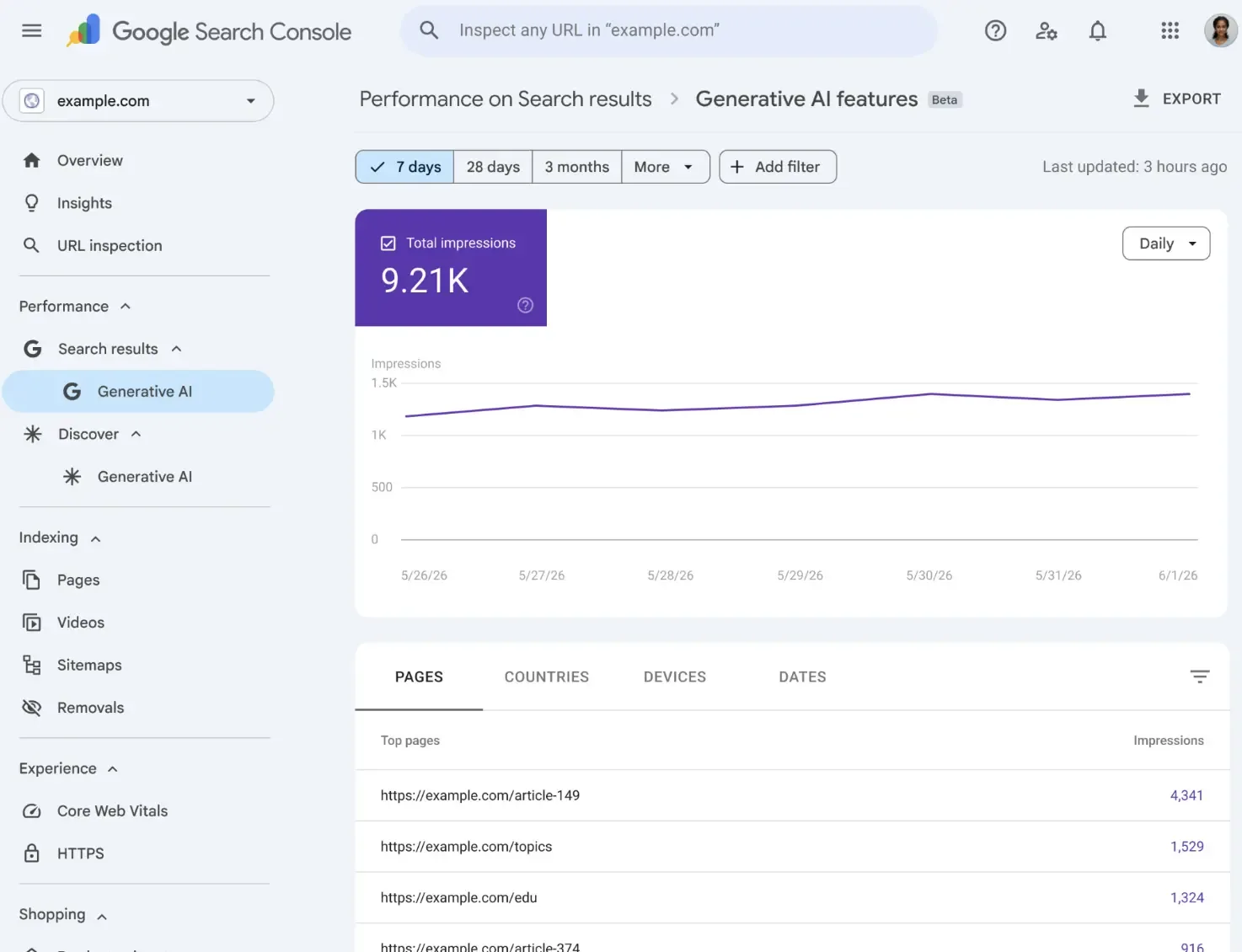
While the reporting is still getting developed, it gives marketers a new way to understand whether their content is being surfaced within AI-generated responses and how that visibility changes over time.
As you review this data, look beyond traditional ranking metrics. Pay attention to which topics, pages, and content types are generating visibility within AI-powered experiences. Those patterns can help identify where your content is earning trust and where additional optimization opportunities may exist.
For years, SEO reporting focused primarily on rankings, clicks, and traffic. Those metrics still matter, but AI-powered search introduces another layer of visibility that marketers should begin monitoring alongside traditional organic performance.
What AI Mode Means for Local SEO
If you manage a local business, AI Mode isn't just changing how customers discover you... It's beginning to change how they interact with you.
One of the most interesting developments in AI Mode is Google's move toward agentic experiences, including calling businesses on behalf of users and helping them complete tasks like scheduling appointments or making reservations.
Think about what that means from a local SEO perspective.
Historically, local search has focused on helping users find information. They search for a business, compare options, visit a website, read reviews, and decide what to do next. AI Mode is designed to reduce some of those steps.
Instead of searching for a dentist, comparing several websites, and calling each office individually, a user could ask AI Mode to find providers that meet specific criteria and check availability for them. The same could apply to restaurants, salons, home service providers, healthcare practices, and countless other local businesses.
That's great for users. It also raises the bar for local SEO.
Google can only recommend, compare, and interact with businesses using the information it has access to. If your Google Business Profile is incomplete, outdated, or inconsistent, you're making it harder for Google's systems to confidently surface your business.
Now is a good time to revisit the fundamentals:
Keep your Google Business Profile accurate and up to date.
Review your business categories and service offerings.
Ensure your hours, contact information, and booking options are current.
Regularly upload photos and respond to reviews.
Maintain consistency across your website, local listings, and other online profiles.
These have always been local SEO best practices. The difference is that they no longer influence visibility alone. They also help Google's AI systems understand your business and determine whether it can confidently recommend you when users ask for help.
As AI Mode continues to expand its agentic capabilities, the businesses that provide the clearest and most complete information may have an advantage when Google decides which options to surface, compare, and recommend.
Takeaways for Marketers
Google AI Mode may be changing how users search, but many of the fundamentals remain the same.
As you adapt your SEO and GEO strategy, keep these principles in mind:
Focus on becoming a trusted source, not just earning rankings.
Create content that demonstrates experience, expertise, authority, and trust.
Anticipate follow-up questions and build content around complete user journeys.
Invest in original research, data, and insights that AI systems can't easily replicate.
Strengthen your brand's entity signals across the web.
Keep your Google Business Profile accurate and complete.
Monitor your visibility across Google's AI-powered search experiences using Search Console.
The brands that succeed in AI-powered search will be the ones consistently publishing helpful, trustworthy information that Google can confidently surface and recommend.
AI-powered search is changing quickly, and most marketing teams don't have time to test every update, feature, and optimization strategy on their own.
If you're trying to understand how AI Mode, AI Overviews, and generative search are affecting your visibility, traffic, and lead generation, we're here to help.
Whether you need a technical SEO audit, a content strategy built for AI-powered search, or guidance on adapting your GEO approach, our team can help you build a search strategy that's ready for what's next.
This blog was originally published on March 27, 2025, and was refreshed and posted on June 17, 2026.

